Blogs

Why Gas-Weighted Minerals May Deserve a Harder Look in 2026

As 2026 unfolds, mineral and royalty owners are hearing more about natural gas again — and for good reason. The conversation is no longer limited to winter weather or short-term price spikes. This year, gas is increasingly being discussed in connection with LNG exports, industrial demand, pipeline takeaway, and the broader role U.S. supply plays in global energy markets.
For owners with gas-weighted acreage, that shift matters. It does not mean every gas property is suddenly a premium asset, and it certainly does not mean buyers will value every tract the same way. But it does mean gas-heavy minerals may deserve a closer look than they would have in a softer market or in a year when export capacity and global demand were moving in the wrong direction.
In our earlier 2026 market outlook, we noted that broader energy trends continue to influence mineral values. This article narrows the lens. For owners whose interests are tied more to natural gas than oil, 2026 presents a set of market conditions worth paying attention to — especially if you are weighing whether to hold, sell, or simply better understand what you own.
What ‘Gas-Weighted’ Usually Means
A gas-weighted mineral interest is one whose present or future value depends more heavily on natural gas production than on crude oil production. In some cases, that means the property sits in a dry-gas play such as Haynesville or parts of Appalachia. In other cases, it may involve associated gas produced alongside oil in places like the Permian Basin.
That distinction matters. Dry-gas and associated-gas assets can respond differently to market conditions. Some benefit more directly from improving natural gas demand, while others are influenced just as much by oil drilling activity, local infrastructure constraints, and regional pricing differentials.
Why 2026 Deserves a Closer Look
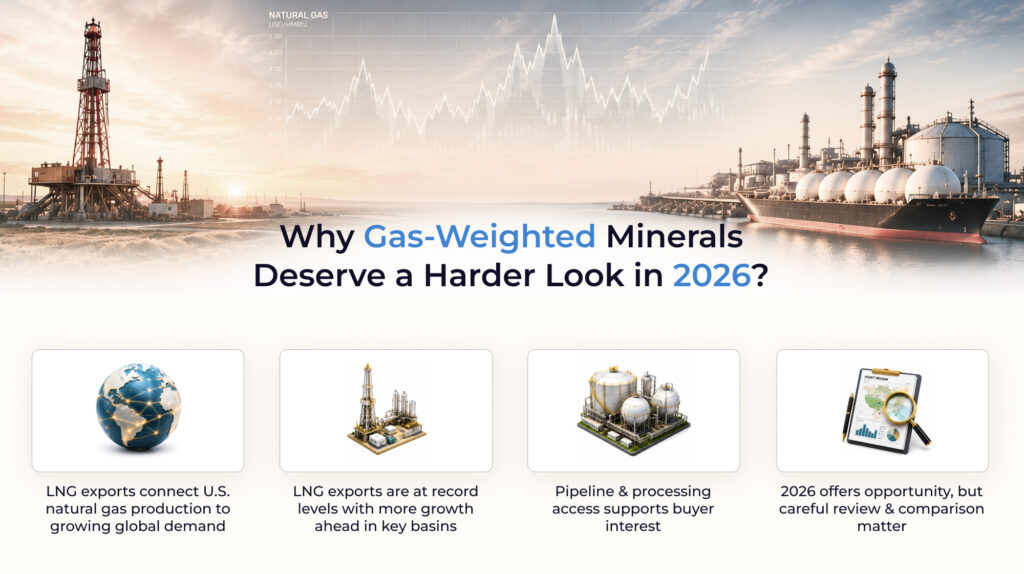
The biggest reason is that natural gas is not just a domestic story in 2026. U.S. LNG exports are expanding again as new facilities come online and existing terminals ramp up. That gives domestic gas production a stronger link to global demand than many mineral owners are used to thinking about.
At the same time, production is rising. U.S. dry natural gas output and exports have both been setting or approaching record levels, and forecast growth is being driven in part by areas that matter directly to mineral owners. That combination — rising supply, growing export pull, and renewed contracting activity — is one reason gas-weighted assets may be drawing more serious attention this year.
Still, this is not a one-way market. Gas remains volatile, global disruptions can move prices quickly, and local constraints can weigh on value even when the national story looks constructive. In other words, 2026 creates opportunity, but it also rewards selectivity.
LNG Growth Is Making Natural Gas More Relevant
One of the clearest themes in 2026 is the continued expansion of U.S. LNG capacity. As export projects ramp up, more U.S. gas is being pulled toward international markets. For mineral owners, that matters because export growth can support demand for domestic production over a longer time horizon than a weather-driven price move ever could.
This does not automatically translate into higher checks every month. But it does improve the strategic case for certain gas-weighted assets, especially those connected to strong basins, reliable operators, and solid pipeline access. When buyers underwrite future value, they are looking at more than today’s spot price. They are also looking at where demand may be headed and whether the asset sits in a region positioned to benefit from that demand.
Not All Gas-Weighted Minerals Benefit Equally
This is where mineral owners need to slow down and avoid broad assumptions. A gas-weighted tract in a strong development corridor is not the same as a gas-weighted tract with weak operator activity, limited takeaway, or heavy deductions. The market may be improving for gas overall, but value is still highly local.
For example, associated gas growth in the Permian can be positive for long-term volumes, yet local bottlenecks and weak basis pricing can limit what producers actually realize. Likewise, a dry-gas asset may look promising on paper, but if the operator has slowed development or the acreage is outside the core of the play, that promise may not show up in a buyer’s offer.
That is why gas-weighted minerals deserve a harder look in 2026 — not a simplistic one.
What Mineral Owners Should Review First
Before making any decision, owners should work through a few practical questions:
- Which basin and county is the interest in, and is it primarily dry gas or associated gas?
- Is the operator active, well-capitalized, and still developing acreage nearby?
- Are there takeaway, gathering, or processing constraints that could reduce realized value?
- Does the lease allow post-production deductions that may affect royalty payments?
- Is the interest already producing, held by production, or still dependent on future drilling?
- How large is the owner’s decimal interest, and is the property material enough to generate meaningful income?
These are not minor details. They are often the difference between a tract that looks attractive in a broad market narrative and one that actually commands meaningful value in the real world.
Why Buyers May Be Looking More Carefully at Gas
When market conditions improve for natural gas, buyers tend to reassess gas-heavy assets that may have received less attention in weaker periods. That can include producing properties with stable gas cash flow, undeveloped acreage in active corridors, and inherited interests that owners have not recently evaluated.
But stronger interest from buyers does not mean owners should jump at the first offer. In fact, a better gas backdrop often makes it more important to compare assumptions. Two offers can look very different based on how a buyer views commodity prices, future development timing, post-production costs, and the operator’s inventory.
Why Lease Terms and Deductions Matter More in Gas Assets
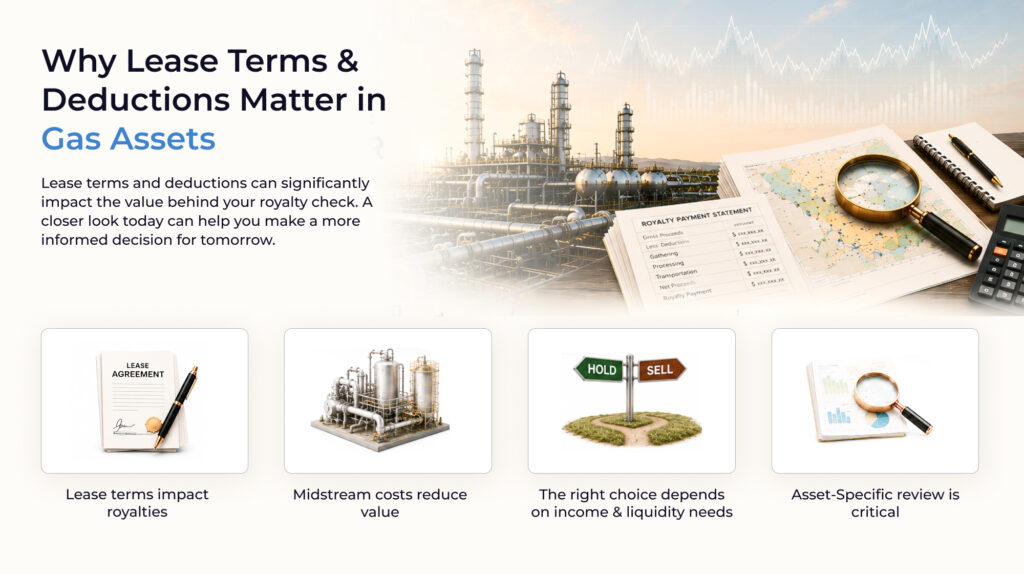
Gas-weighted minerals often require a closer look at lease language than oil-heavy assets do. Gathering, compression, processing, and transportation can all affect the price basis behind a royalty check. Even in a favorable gas market, those downstream costs can materially affect what ends up in the owner’s pocket.
That means mineral owners should not focus only on gross production or headline market trends. They should also review how their lease handles deductions, whether the operator or purchaser is netting certain costs from proceeds, and whether the royalty language is as owner-friendly as they assume.
What This Could Mean for Hold vs. Sell Decisions
For some owners, a constructive 2026 gas outlook may support a decision to hold, particularly if the property sits in an active basin with a credible operator and meaningful future drilling potential. For others, stronger gas sentiment may make this an opportune time to test the market and compare offers while buyer interest is improving.
The right answer depends on the asset and on the owner’s goals. Some owners want current income. Others want liquidity, estate simplification, or relief from paperwork. A better gas market does not eliminate those priorities. It simply changes the context in which the decision is made.
How Allegiance Oil & Gas Helps
At Allegiance Oil & Gas, we work with mineral and royalty owners who are trying to understand not just what the market is doing, but what it means for their specific property. Gas-weighted minerals can be harder to evaluate than they first appear because basin quality, infrastructure, operator plans, and lease deductions all matter.
Our role is to help owners cut through the noise. Whether you are trying to understand a current offer, assess the long-term potential of inherited acreage, or decide whether now is the right time to sell, we focus on clear, practical guidance rooted in the actual asset.
Final Thoughts
Natural gas is earning a closer look in 2026 because the backdrop is different than it was in many recent periods. LNG export growth, rising production, and stronger long-term demand signals are giving certain gas-weighted minerals a more constructive story. At the same time, volatility, regional pricing, and property-specific factors still matter just as much as ever.
That is why the right takeaway is not that all gas-heavy minerals are suddenly more valuable. It is that owners should not overlook them. In the current market, gas-weighted interests may deserve a more careful review than they have in the past — especially if an offer, inheritance event, or ownership decision is already forcing a closer look.
Disclaimer: This article is for general informational purposes only and is not legal, tax, or investment advice. Market conditions and mineral values vary by basin, operator, lease terms, title history, and the specifics of each property.