Blogs

Should You Sell All of Your Mineral Interest — or Just a Portion?
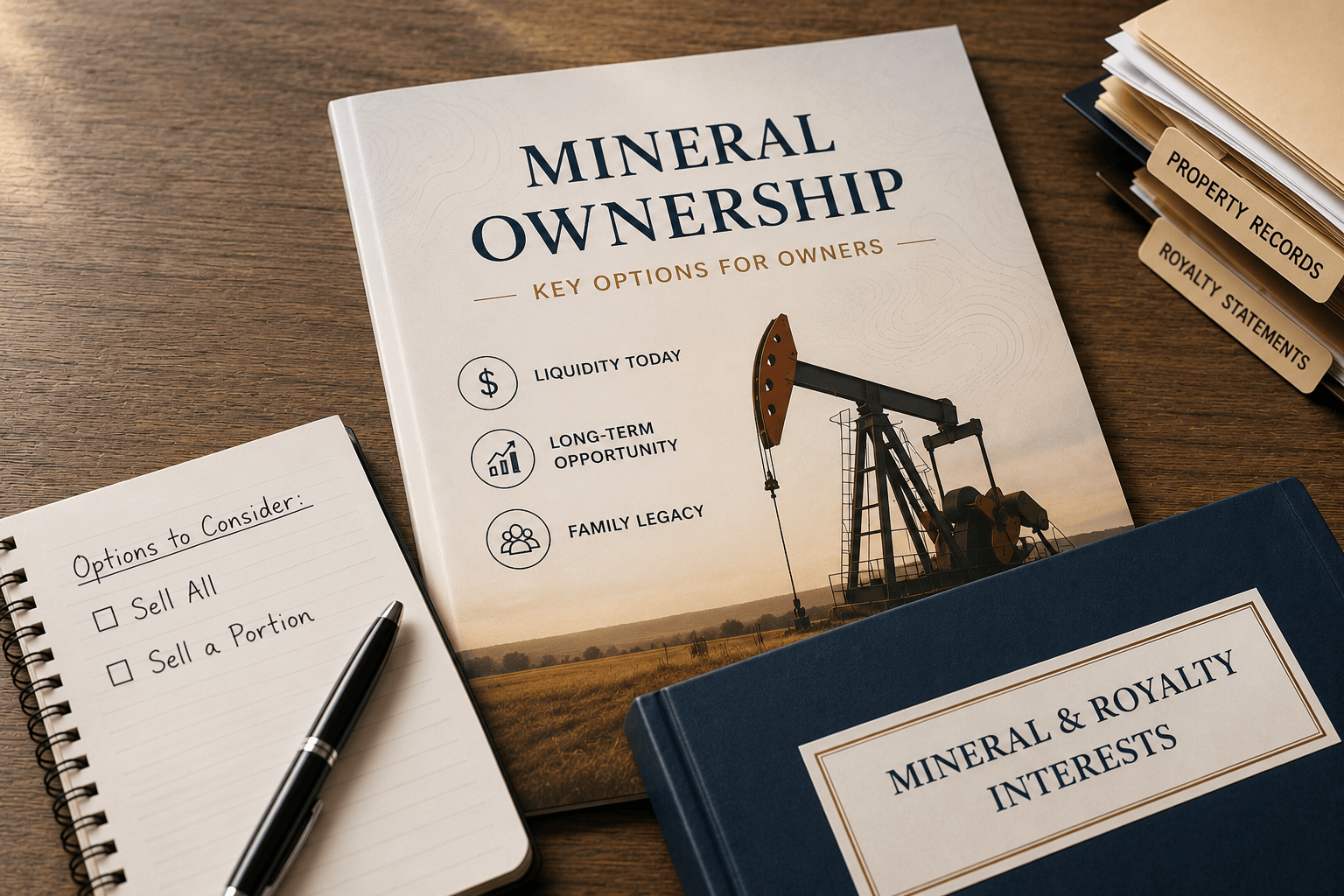
For many mineral owners, the decision is framed as a simple yes-or-no question: should I sell, or should I keep what I have? In reality, that is often too narrow a way to think about it.
In the real world, many owners are not choosing between two extremes. They are trying to solve a more practical problem. They may want some liquidity, some simplification, or some protection against future uncertainty — without giving up every bit of future upside. That is where a partial sale can come into the conversation.
The right answer depends on the quality of the asset, the family’s goals, the owner’s tolerance for paperwork and volatility, and the value the market is actually placing on the interest today. Below is a practical look at when selling all of a mineral interest may make sense, when selling only a portion may be the better move, and what owners should review before making either decision.
Why This Decision Is Not as Simple as It Sounds
Mineral interests are not like a savings account, and they are not quite like ordinary real estate either. They can produce meaningful income for years, but that income may rise, fall, or stop based on drilling activity, commodity prices, lease terms, deductions, operator decisions, title issues, and a long list of other moving pieces.
That is why the phrase “sell or keep” can be misleading. Some owners want to reduce risk but still retain exposure to future wells. Others want to clean up part of the asset for estate-planning reasons while keeping the rest in the family. Still others have reached the point where the administrative burden outweighs the benefit of continued ownership.
A full sale and a partial sale are both legitimate options. The key is understanding what problem you are actually trying to solve.
What a Partial Sale Actually Means
A partial sale means exactly what it sounds like: the owner sells only part of the mineral or royalty interest and keeps the rest. That can be structured in different ways. An owner may sell a percentage of the total interest, sell only certain tracts or counties, or sell selected properties while retaining others.
For the right owner, that middle-ground approach can create flexibility. It can convert a portion of the asset into cash today while preserving some long-term upside if new wells are drilled or existing production performs better than expected. But it is not automatically the right choice simply because it sounds safer. In some situations, keeping a smaller retained interest does not actually eliminate the problems that made ownership difficult in the first place.
Common ways owners think about a partial sale
- Raise liquidity now while keeping some exposure to future royalties.
- Reduce family concentration in one asset class without exiting completely.
- Sell lower-priority acreage while retaining the properties with the strongest upside.
- Create a cleaner split among heirs or co-owners with different goals.
- Test the market before deciding whether a larger sale makes sense later.
When Selling Only a Portion May Make Sense

1. You want liquidity, but you do not want to give up all future upside
This is one of the most common reasons owners consider a partial sale. They may have a real financial need today — debt reduction, estate expenses, diversification, family support, or a major purchase — but they are not comfortable walking away from the asset completely. A partial sale can meet that need without turning the decision into an all-or-nothing bet.
2. Your interests are spread across properties of uneven quality
Not every tract in a portfolio deserves the same treatment. Some properties may have stronger operators, cleaner title, better development potential, or more favorable lease economics than others. In that situation, selling selected acreage while keeping the best-positioned assets may be more sensible than treating the entire portfolio as one block.
3. You want to reduce exposure to uncertainty
Mineral ownership can create upside, but it also comes with uncertainty. Owners may be dealing with declining wells, uneven payment patterns, operator slowdowns, title cleanup, or difficulty forecasting long-term value. Selling a portion can reduce exposure to those unknowns while still preserving some participation if the property performs well later.
4. Multiple heirs or family members do not want the same thing
Family-owned minerals often become difficult when one person wants current cash, another wants long-term income, and another has little interest in handling the paperwork at all. A partial sale can sometimes provide a practical compromise. It does not solve every family issue, but it can create room for a more workable ownership structure.
5. You want to simplify, but not completely exit
Some owners simply want fewer statements, fewer owner-relations calls, fewer tax records, and less uncertainty. A partial sale may reduce the scale of the administrative burden while allowing the owner to keep a meaningful retained interest. That said, owners should be honest with themselves here: keeping a small piece can still mean continuing to deal with forms, addresses, 1099s, title issues, and suspended-payment problems. Partial sales reduce complexity, but they do not always eliminate it.
When Selling the Entire Interest May Be the Cleaner Choice
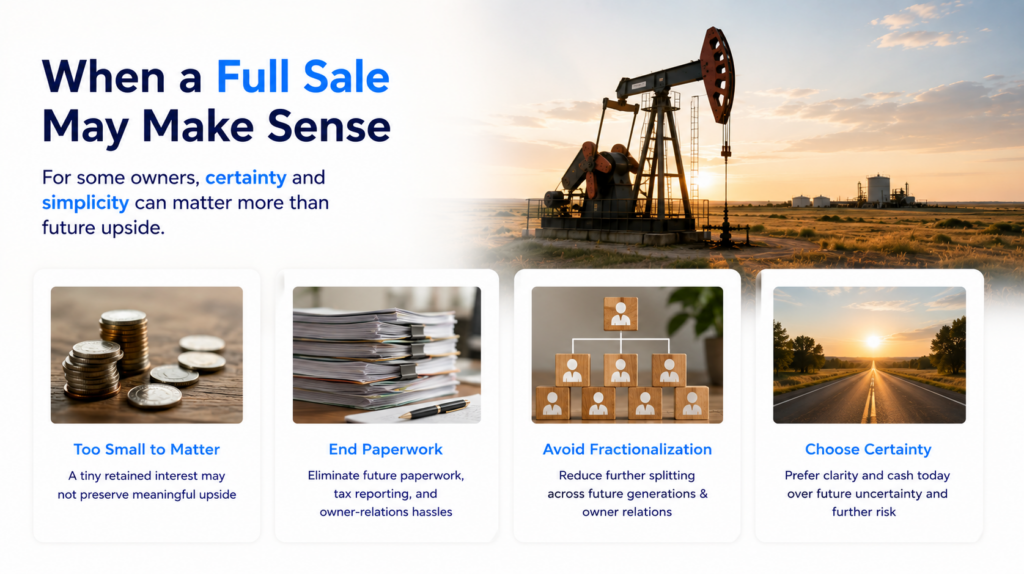
A partial sale can sound appealing because it feels more cautious. But sometimes the cleanest, most rational choice is to sell the entire interest and move on.
That may be especially true when the owner’s main goal is simplification. If the property is small, heavily fragmented, difficult to manage, or unlikely to be meaningful in the context of the owner’s overall finances, keeping a retained slice may only preserve the paperwork while doing little to preserve meaningful upside.
A full sale may also make more sense when the owner no longer wants exposure to commodity cycles, title work, operator changes, or future family administration. In those situations, the value of certainty, clarity, and closure can be just as important as the dollar amount of the offer itself.
A full sale often deserves a harder look when:
- The retained interest would be too small to matter economically.
- The owner wants to eliminate future paperwork and tax reporting.
- The family is trying to avoid further fractionalization across generations.
- The property is non-core, hard to evaluate, or burdened by messy administration.
- The owner strongly prefers certainty today over potential upside later.
What Owners Should Review Before Choosing Between a Full Sale and a Partial Sale
Current production and cash flow
Is the interest producing today? If so, how stable is that production, and how meaningful is the revenue relative to the owner’s broader financial picture? A producing property with solid recent cash flow raises different questions than a non-producing property that is mostly being valued on future potential.
Operator quality and development plans
An asset tied to an active operator in a strong development corridor is different from one in an area with little recent activity. Before deciding what to sell, owners should look not just at historic payments, but at whether future development seems realistic.
Lease terms and deductions
Two seemingly similar mineral interests can perform very differently depending on the lease. Post-production deductions, royalty language, depth limitations, and other provisions can materially affect what future payments look like. That matters whether the owner is keeping everything, selling everything, or retaining only the “best” portion.
Title condition and administrative burden
If the file is messy — missing deeds, old estates, address problems, unresolved curative, or suspended funds — that should be part of the decision. In some cases, a partial sale of a difficult asset can leave the owner with the least attractive piece of the problem. In others, a targeted sale can reduce the clutter. Either way, owners should understand the file before assuming a partial sale is automatically cleaner.
Tax and estate-planning consequences
The structure of the sale matters. Owners should think through whether they are trying to generate liquidity, equalize value among heirs, reduce future administration, or simply reallocate wealth. The “best” answer on paper may not be the best answer once taxes, trusts, probate planning, or family goals are considered.
How much of the upside you are truly willing to part with
This is the question many owners avoid. It is easy to say you want cash now and upside later. It is harder to decide how much upside you are genuinely comfortable selling away. A thoughtful owner should define that line before reviewing offers, not after.
A Few Questions Worth Asking Before You Sign Anything
- Am I trying to solve for liquidity, simplicity, risk reduction, family fairness, or something else?
- If I keep a retained interest, will it still be large enough to matter?
- Am I retaining the strongest part of the asset, or simply the part that is hardest to sell?
- Would a smaller retained interest still leave me with most of the paperwork I am trying to avoid?
- Have I compared the value of a full sale against the value of a partial sale in a meaningful way?
- How does this decision fit with my broader tax, estate, and financial planning?
Those questions sound simple, but they often change the conversation. The goal is not to force every owner into a partial sale or a full sale. The goal is to make sure the structure of the transaction matches the problem the owner is actually trying to solve.
How Allegiance Oil & Gas Helps
At Allegiance Oil & Gas, we work with mineral and royalty owners who are often weighing more than just price. They are thinking about family goals, title issues, future upside, administrative burden, and whether a transaction should be all-or-nothing in the first place.
That is why we believe owners should understand the asset before rushing into a structure. In some situations, selling all of an interest is the cleanest answer. In others, a partial sale may create a better balance between current liquidity and retained upside. Either way, the decision should be made with clarity, not pressure.
Final Thoughts
For mineral owners, the best decision is rarely the one that sounds most dramatic. Sometimes the right answer is to sell the entire interest and simplify life. Sometimes the better move is to sell only a portion, reduce exposure, and keep a seat at the table for what comes next.
The key is not to assume that every offer must lead to an all-or-nothing choice. A mineral interest is a real asset, but it is also a family asset, an income asset, and in many cases an administrative burden. Good decisions come from understanding which of those roles matters most to you right now.
If you are weighing whether to sell all of your mineral interest or only part of it, Allegiance Oil & Gas can help you think through the practical differences so you can make an informed decision with confidence.
Disclaimer: This article is for general informational purposes only and is not legal, tax, or investment advice. Owners should consult qualified legal, tax, and financial professionals regarding the facts of their specific situation before making any sale decision.