Blogs

Decline Curves Explained: Why Royalty Checks Change After a New Well Comes Online

A new well can make a royalty statement exciting. The first few checks may be noticeably larger than anything an owner has received before, and it is natural to wonder whether that level of income will continue. Then, a few months later, the production volume starts to fall. The check follows it down. Nothing obvious has changed with the ownership decimal, the well is still producing, and the operator has not announced a problem.
In many cases, that pattern is normal. Oil and gas wells do not usually produce at a constant rate for their entire lives. Production is generally strongest early, then declines over time as reservoir pressure falls and the easiest-to-produce hydrocarbons are recovered. The shape of that decline is what industry professionals describe with a decline curve.
For mineral and royalty owners, decline curves matter for more than engineering. They help explain why royalty checks change, why one month should not be treated as a permanent income level, and why buyers value future production differently from cash already being received today.
What Is a Decline Curve?
A decline curve is a way of showing how a well’s production rate changes over time. At the beginning of a well’s life, production may be high. As the reservoir is depleted and pressure falls, the monthly production rate typically declines. Eventually, the decline often becomes more gradual and the well may continue producing at a lower rate for years.
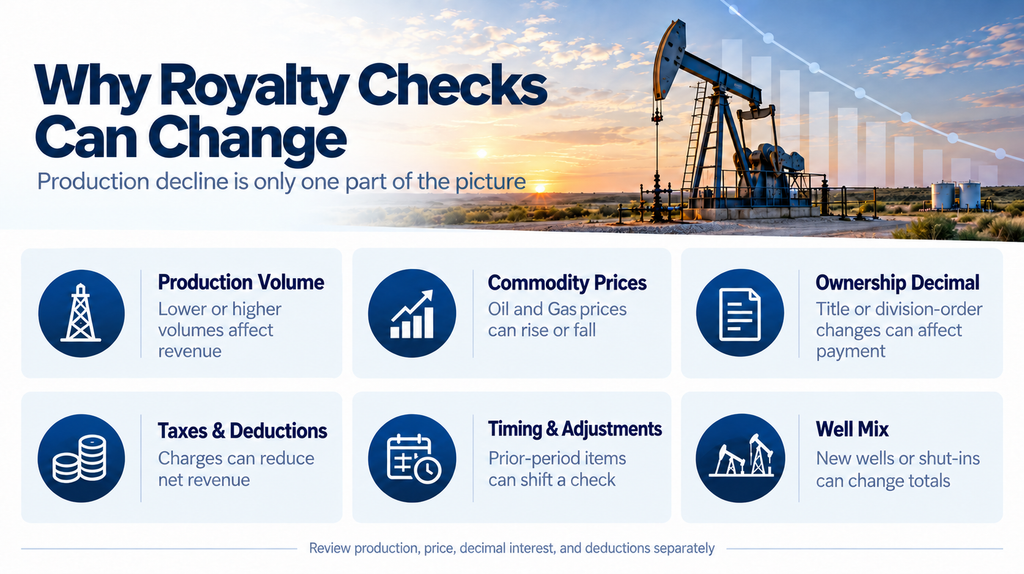
The important point is that a decline curve describes production volume, not the royalty check itself. Your check is influenced by several moving pieces at once: production, commodity prices, your ownership decimal, taxes, post-production deductions, prior-period adjustments, and sometimes the addition or removal of wells from the property or unit.
That distinction matters. If production falls 20% while commodity prices rise sharply, the check may not fall 20%. If production is stable but prices weaken, the check may still shrink. A revenue statement is therefore more useful than the check amount alone when trying to understand what changed.
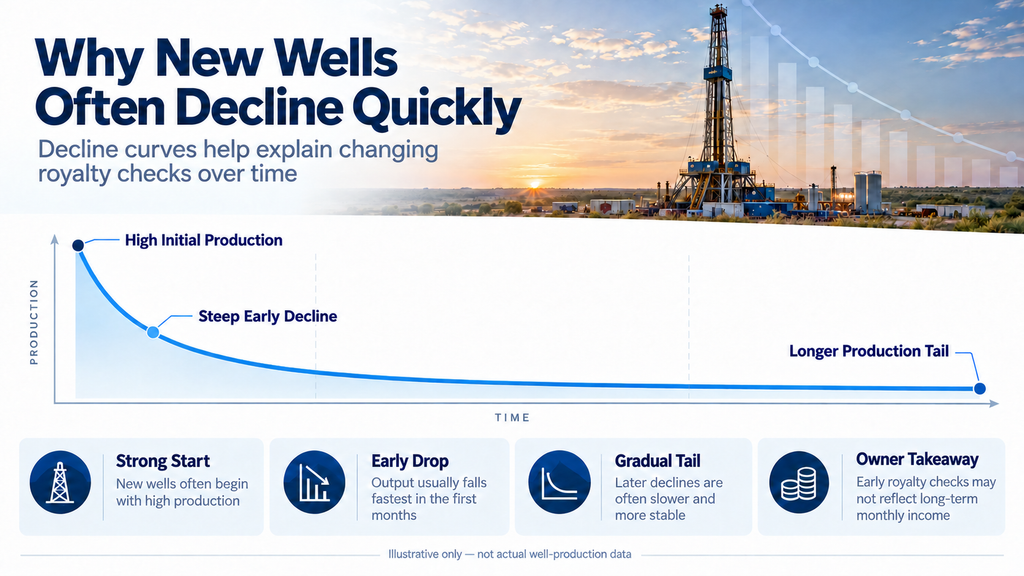
Modern horizontal wells are designed to contact a large amount of reservoir rock and bring substantial production online quickly. Hydraulic fracturing creates pathways through which oil and gas can move toward the wellbore. The result can be a strong initial production rate, especially in high-quality acreage.
But high initial production often comes with a steep early decline. The U.S. Energy Information Administration has noted that horizontal wells generally exhibit higher decline rates than vertical wells and that operators must continue adding new wells to offset the decline from existing production. That is one reason basin-wide production can stay strong even though individual wells are steadily declining.
For a mineral owner, the practical takeaway is simple: the first royalty checks from a new horizontal well can be unusually strong, but they should not automatically be viewed as the new normal.
The 24-Month Rule of Thumb
A popular industry rule-of-thumb says that roughly one-half of all the production a newly drilled unconventional well will ever produce may come during the first 24 months after it comes online. It is a useful mental model because it captures the front-loaded nature of many shale wells: a large share of the economic value can arrive early, while the remaining production is spread over a much longer tail.
| Important: The ‘half in the first 24 months’ idea is a rule-of-thumb, not a universal engineering law. Actual results vary materially by basin, oil versus gas mix, geology, lateral length, completion design, operating practices, commodity economics, and the method used to estimate a well’s ultimate recovery. |
Published examples show why the caveat matters. Research on some shale-gas wells has found that 60% to 70% of expected ultimate recovery can occur in the first two years, while other oil-well examples have projected substantially less. The exact percentage is not the point. The useful lesson for owners is that newly completed wells are typically front-loaded, and the early checks can overstate what a normalized long-term monthly payment will look like.
A Simple Example: Why the First Check Can Be Misleading
Imagine that a new well comes online and produces 20,000 barrels during an early month. Over time, monthly production falls to 14,000 barrels, then 10,000, then 7,000. If the commodity price, ownership decimal, taxes, and deductions were all unchanged, the owner’s royalty revenue would generally move in the same direction as production.
That does not mean the well is failing. It may be behaving exactly as expected. The mistake would be to take the first large check, multiply it by 12, and assume that amount represents a dependable annual income stream for the next several years.
This is especially important when a family is budgeting around a new well, evaluating whether to sell an interest, or estimating what the minerals may be worth. Early production is real income, but it is not necessarily recurring income at the same level.
Decline Rate and Royalty Check Are Related – But They Are Not the Same Thing
When a royalty check gets smaller, production decline is one possible explanation, but it should not be the only assumption. A good review separates the components.
- Production volume: Did the oil, gas, condensate, or natural gas liquids sold during the month decrease?
- Commodity price: Did the realized sales price change from the prior month?
- Ownership decimal: Is the decimal interest unchanged, or was there a pooling, title, or division-order adjustment?
- Deductions and taxes: Did post-production charges, severance taxes, or other deductions change?
- Timing and adjustments: Does the statement include prior-period corrections, recoupments, or sales from more than one production month?
- Well mix: Did a new well begin paying, did one stop producing, or are several wells now being combined on the same statement?
Our earlier posts on How to Read a Revenue Statement and Post-Production Deductions Explained are useful companions here. A smaller check is much easier to understand when production, price, decimal interest, and deductions are reviewed separately rather than treated as one number.
What Happens After the Steep Early Decline?
Decline does not mean a well immediately stops producing. Many wells transition from a steep early decline into a much flatter production tail. At that point, the monthly volumes may be much lower than they were during the first year, but the well can continue generating royalties for a long time if it remains economic to operate.
This is one reason a mineral interest should not be judged only by whether the latest check is smaller than last year’s. A mature well may still have meaningful remaining production, and undeveloped locations, offset activity, recompletions, or additional wells can materially change the future income picture.
The reverse is also true: a high current check should not automatically be treated as proof that the same level of cash flow will continue. Understanding where each well sits on its decline curve helps put today’s payment in context.
One New Well Can Temporarily Reset the Payment Pattern
Mineral owners with several wells often see a saw-tooth payment history rather than a smooth line downward. An older group of wells may be declining steadily, then a new well is completed and total property production jumps. The royalty checks rise sharply again, followed by another period of decline as that new well matures.
That pattern can repeat several times on actively developed acreage. It is why evaluating minerals from a single check, or even a single year of checks, can be misleading. The development history and the operator’s remaining drilling inventory often matter just as much as the production already on line.
Why Decline Curves Matter When Your Minerals Are Valued
A buyer evaluating producing minerals is not simply adding up last year’s royalty checks and applying a multiple. A more complete valuation forecasts future production from the existing wells, applies assumptions for commodity prices and expenses, and discounts those future cash flows back to a present value.
The decline curve is central to that forecast. If a well is only a few months old, a large portion of its early production may still be ahead, but so is a steep decline. If a well is several years old, current production may be lower but more stable. Two interests generating the same royalty check today can therefore have very different future cash-flow profiles.
Potential future drilling adds another layer. A property with mature wells but credible undeveloped locations may carry value that is not visible in today’s royalty statement. Conversely, a property with a very strong new-well check but little remaining development inventory may be more dependent on the declining production already in place.
This is also why Allegiance’s prior discussion of energy-market trends emphasized long-term price expectations, production decline rates, operator performance, and drilling plans together rather than relying on a single current-month metric.
What Mineral Owners Should Watch After a New Well Comes Online
You do not need to build an engineering model to recognize whether a royalty stream is behaving reasonably. A few simple habits can provide useful context.
- Keep the first 12 to 24 months of revenue statements. Early statements create a useful baseline for production, prices, deductions, and the ownership decimal.
- Track production by well, not only the total check. A combined payment can hide the fact that one well is declining while another has just started producing.
- Compare volumes before comparing dollars. If the check drops, first determine whether production fell, the realized price changed, or both.
- Do not annualize the biggest early check. A first-month or early-month payment from a new horizontal well can be unusually high relative to the long-term average.
- Watch for changes that are too abrupt to explain by ordinary decline alone. A sudden disappearance of a well, a changed decimal, an unfamiliar deduction, or a zero-payment month may deserve a separate review.
- Pay attention to new permits and nearby development. Additional wells can materially alter a property’s future royalty profile.
When a Smaller Check May Deserve a Closer Look
Normal decline is gradual enough to be seen in production history, even when it is steep early in a well’s life. Some payment changes, however, may point to something else.
A sudden drop should prompt questions if the reported production did not change, the ownership decimal is different without explanation, deductions increased sharply, a well disappears from the statement, or the operator reports a status change you do not understand. Likewise, if public production data and the revenue statement appear materially inconsistent, it may be worth asking owner relations for clarification.
The goal is not to treat every smaller check as an error. It is to separate ordinary reservoir decline from pricing changes, statement mechanics, title issues, deductions, or operational events.
How Allegiance Oil & Gas Looks at Declining Production
At Allegiance Oil & Gas, producing mineral interests are evaluated as future cash-flow assets, not simply as a stack of recent checks. Existing well performance, decline behavior, commodity pricing, operator quality, location, and remaining development potential all contribute to the picture.
That matters whether an owner plans to hold the interest or is considering an offer. If today’s payment is coming from a newly completed well, understanding how much of that cash flow is likely to decline can help set realistic expectations. If the wells are mature, understanding the remaining production tail and future drilling potential can be just as important.
A good mineral decision starts with knowing what part of the current income is likely to repeat – and what part reflects the unusually productive early life of a new well.
Final Thoughts
Decline curves explain one of the most common surprises in mineral ownership: a new well can be performing normally even while the royalty check gets smaller. Many unconventional wells produce a disproportionately large amount early in their lives, then settle into a lower, longer production tail.
The industry rule-of-thumb that roughly half of lifetime production may arrive in the first 24 months is a useful way to remember that front-loaded pattern, but it should never be treated as a prediction for every well. Basin, geology, completion design, product mix, and operating conditions can all change the curve.
For owners, the practical lesson is to look beyond one check. Review the production volumes, follow the well over time, separate production decline from price and deduction changes, and consider the remaining development picture before drawing conclusions about long-term value.
Disclaimer: This article is for general informational purposes only and is not engineering, legal, tax, accounting, or investment advice. Production behavior and decline rates vary materially by well, basin, geology, completion design, operator, commodity, and economic assumptions. Mineral and royalty owners should consult qualified professionals regarding their specific interests and circumstances.