Category Archives: Mineral & Royalty Interests

How to Read a Revenue Statement

Understanding your royalty payments from oil and gas production is vital in order to ensure accurate, timely, and complete issuance of all production revenue to which you are entitled as a royalty owner. The most critical piece of information available to royalty owners for review and validation of their payments is the revenue statement.

What Is A Revenue Statement?

Revenue statements are typically received along with the royalty checks issued to royalty owners each month, and the data they contain is required by law to be issued to you as a royalty owner.

The checks and associated revenue statements are sent to you by the purchaser of the oil, gas, or other hydrocarbons being produced from the wells associated with your royalty. Although the purchaser is very commonly the same as the operator of the wells drilled on your acreage, this isn’t always the case, as operators can make arrangements for a different company to purchase all of the produced commodities from the wells, in which case the company purchasing the hydrocarbons would be referred to only as the “purchaser” and would have the responsibility of producing and issuing checks and revenue statements for all purchased hydrocarbons. Note that, in some cases, an operator may contract with a different purchaser for each the oil and natural gas production from your wells, in which case multiple checks and revenue statements will be received each month, one for each production type.

The revenue statements you receive contain a breakdown of how your payment is calculated, detailing production volumes, commodity prices, deductions and other factors. The statements can seem complex at first glance, but they’re actually quite simple once you understand a few common, key components.

Key Components of a Revenue Statement

Each revenue statement typically includes the following components:

1. Operator Information & Payee Details

At the top of your revenue statement, you will find details about the operator or purchaser issuing the payment. This section usually includes:

  • Purchaser’s name and contact information
  • Your owner number or account number (used for internal tracking at the purchaser)
  • The check date and check number

Errors in ownership details can cause payment delays or misallocation, so it’s critical to ensure that all of this information is correct upon receipt of your first payment.

2. Well and Lease Information

Each revenue statement includes specific information about the well(s) or lease(s) generating your royalties. This section contains:

  • Lease or well name
  • API number (a unique identifier for each oil and gas well)
  • County and state of production
  • Type of interest held, such as Royalty Interest (RI) or Working Interest (WI)
  • Interest percentage (often referred to as the “Decimal Interest”)

If you own interests in multiple wells, your revenue statement will list each one separately.

3. Production Volume and Sales Data

This section of the statement tells you about the amount of oil, natural gas, or other hydrocarbons produced and sold during a specific time period. It includes:

  • Production Date: The month and year when production occurred
  • Product Code: Indicates whether the product is oil, gas, natural gas liquids (NGLs), or some other hydrocarbon product
  • Volume Sold: The quantity sold, typically measured in barrels (Bbl) for oil and thousand cubic feet (Mcf) for natural gas, with varying units of measurement for other product types
  • Price Per Unit: The sales price received per unit of production (typically per Bbl for oil and per MCF for natural gas)
  • Gross Revenue: The total sales revenue before deductions

Because production and sales are reported monthly, payments are typically received 1-2 months after the production actually occurs.

4. Deductions and Expenses

One of the most scrutinized sections of a revenue statement is the deductions, which account for post-production costs. These may include:

  • Transportation Costs: Fees for moving the product via pipeline, truck, or rail
  • Processing Fees: Costs associated with refining or treating the product
  • Marketing Costs: Expenses for selling the hydrocarbons
  • Severance Taxes: State-imposed taxes on resource extraction

Not all royalty owners are subject to post-production deductions—this depends on your oil & gas lease (OGL) terms. It is critical to review the deductions reported on your revenue statement versus the deductions agreed to on your OGL to ensure that the purchaser is not deducting disallowed costs from your revenue share.

5. Net Revenue and Payment Amount

After all calculations and deductions, the final section of your revenue statement shows:

  • Net Revenue: The amount due to you after deductions and taxes
  • Check Amount: The actual payment issued, typically visible at the bottom of the revenue statement and on the check itself
  • Year-to-Date Totals: A summary of earnings and deductions for the year, typically shown at the bottom of the revenue statement

If your revenue statement shows a negative balance, that means that deductions exceeded revenue, which may result in no payment for that period. This is a very rare occurrence for a standard royalty interest (RI) owner, so this should be reviewed extremely carefully if it does occur.

Common Issues and Red Flags

While most revenue statements are accurate, errors can occur. Here are some common issues to watch for:

  • Volume Discrepancies: Ensure production volumes match publicly available data from state oil and gas regulatory agencies. In Texas, for example, the Texas Railroad Commission (RRC) aggregates production data from all wells in the state, as reported by operators. The RRC performs audits randomly to ensure that operators are reporting accurately, so the data at the RRC can generally be considered accurate and verified. This data can be a useful cross-reference against revenue statements.
  • Incorrect Pricing: Verify commodity prices align with market rates for the production period. In the case of large discrepancies, an inquiry should be made with the operator or purchaser of your hydrocarbons as to their substantiation for the pricing being used.
  • Disallowed Deductions: Review post-production charges to ensure they comply with your oil & gas lease (OGL) agreement.
  • Interest Percentage Errors: If your ownership interest is incorrect in the records of the purchaser, your payments are very likely also miscalculated.

Best Practices for Managing Your Revenue Statements

  • Keep Records: Maintain a file of all revenue statements for tax and audit purposes, as well as for general future reference in case payment discrepancies are identified at a future date.
  • Use Accounting Software: If your royalty interest holdings are substantial, consider tracking your royalties with specialized accounting software to analyze trends and ensure that the 1099s received each year from purchasers are reconciling with your royalty deposits. This process can identify checks lost in the mail.
  • Ask Questions: If something looks off, contact the operator, purchaser, or another oil & gas professional such as a landman or oil & gas attorney to dig deeper.

Understanding and verifying oil and gas revenue statements is the first critical step to responsible management of mineral and royalty interests.

Mineral Rights

Leasing Your Mineral Rights: Key Terms To Negotiate

If you’re a property owner and you’ve been contacted by an oil and gas operator about leasing your mineral rights, it’s essential to understand the process, where you may have negotiating power, and the terms that could most significantly impact your financial and legal standing down the road. Although being leased is almost always a good thing, you should never sign a lease without a careful review and negotiation.

Understanding the Oil & Gas Lease (OGL)

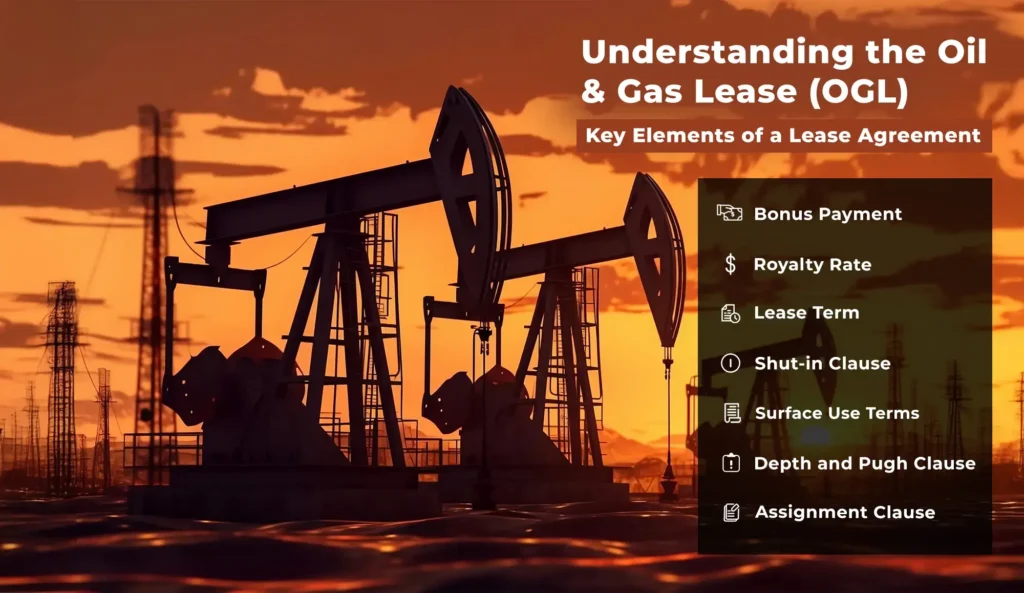
An Oil & Gas Lease (OGL) is a contractual agreement that allows an operator to explore and extract hydrocarbons from beneath your property in exchange for compensation. These leases typically consist of key provisions that define the rights and obligations of both the lessor (mineral owner) and the lessee (operator).

Defining Key Lease Terms

Before discussing negotiation, let’s first establish definitions for the most common terms in an OGL:

  1. Bonus Payment – A one-time upfront payment to secure the lease.
  2. Royalty Rate – The percentage of production revenue paid to the mineral owner.
  3. Lease Term – The primary duration of the lease (e.g., 3-5 years) and any extension options.
  4. Shut-in Clause – Defines conditions under which the operator can suspend production while retaining the lease.
  5. Surface Use Terms – If you also own the surface rights, this dictates how the land can be accessed and utilized.
  6. Depth and Pugh Clause – Determines if and how unused depths or acreage revert to the owner if drilling does not occur on them within the lease term.
  7. Assignment Clause – Describes if and how the lease agreement can be transferred to another company.

The Most Important Lease Terms To Negotiate

Generally, the first draft of an OGL will be supplied by the operator seeking to lease your acreage, leaving you to review the terms therein, negotiate where appropriate, and ultimately finalize & sign. For common lease terms, here are some general rules-of-thumb:

  • Royalty Ranges: Royalty rates should typically be between 12.5% and 25%, with relatively few exceptions. Higher rates benefit the mineral owner (lessor) and lower rates benefit the operator (lessee). The exact rate within the 12.5% to 25% range will depend on your region – and your negotiation. If your area is highly sought-after for drilling (think “major basins / plays” like the Permian, Eagle Ford, etc.) then you are more likely to be towards the top end of this range. If drilling occurs less frequently or densely in your area, you are probably looking toward the lower end. Any proposed royalty rate outside of the 12.5% to 25% range is typically a major red flag, demanding a clear explanation; if you see this, you are possibly negotiating with someone inexperienced or looking to take advantage in some way.
  • Primary Lease Term: These are usually 3 to 5 years, often with an optional extension period. Obviously, shorter primary terms benefit the mineral owner and longer terms benefit the operator, giving them more time flexibility. Generally, primary lease terms should increase and decrease in correspondence with the lease bonus payment, not the royalty rate, as the lease bonus is guaranteed while drilling activity is not.
  • Bonus Payments: These vary tremendously based on market demand and location, so it is difficult to create any blanket rules-of-thumb – however, you should consult with other owners who have been leased nearby, if possible, or a disinterested professional familiar with your area, to cross-reference any bonus amount proposed in order to assess whether it is in-line with market or not.
  • Depth and Pugh Clause: It is important that your lease is written in such a way that you (the mineral owner) are allowed to re-lease as many of your acres and depths as possible in the event that the operator fails to drill on them by the end of the primary lease term. If your Depth & Pugh Clause does not aggressively return the acreage to you, it is possible that an operator will hold captive a large amount of your productive acreage for the 30+ year life of a single producing well, costing you potential lease bonuses & royalties from incremental production.
  • Assignment Clause: It is common for an operator to require a lease to be broadly assignable, and this is not in-and-of-itself a red flag. However, if you see this term in your lease, you may wish to inquire with the lessee as to what, if any, plans they have to assign the lease as of the time of your signature. You will sometimes learn that the company leasing from you is in fact a contractor working for a larger operator and plans to collect and assign numerous leases in the area to the larger operator. Although this is also somewhat common, it will be useful for you to know the name of the operator that will ultimately be drilling on your acreage.

Less Focal (But Negotiable) Terms

  • Gross vs. Net Royalty: Operators may deduct post-production costs; a “gross proceeds” clause ensures your royalty is calculated before these deductions. What is appropriate depends entirely on your region, so if this is a material consideration for your lease, you should consult a professional.
  • Continuous Development Clause: Requires the operator to drill additional wells to maintain the lease. These are favorable to the lessor and should be strongly considered if the operator is leasing a very large number of acres.
  • Indemnity Clause: Protects the mineral owner from liabilities due to operational accidents. This benefits the mineral owner and should be included in every OGL signed. This is usually boilerplate language that will automatically be included by the operator at the time of sending over a proposed OGL in the first place, but if this is not present, this should be requested.

Remaining Lease Terms

Most other OGL terms are less significant to a negotiation than those above, but ALL terms in your OGL should be carefully reviewed to ensure they are generally reasonable and pass the sanity-check of a rational person (you). As an example, although uncommon, if your OGL allowed wells to be shut-in for egregiously long periods of time while still holding your lease, this would be a red flag and would require explanation from the operator.

Conclusion

Generally, all OGLs are negotiable to some degree, so mineral owners should feel empowered to dig into the document and press back on any unfavorable terms. By taking a proactive approach to the leasing process, mineral owners can ensure they secure agreements that deliver lasting value while safeguarding their assets.

Types of Mineral Rights

Types Of Mineral Rights & Royalty Interests

Mineral and royalty interests in the United States come in various forms, each representing some form of ownership of, or profit-sharing right in, the production of oil, gas or other subsurface hydrocarbons from a particular parcel of land. 

It is critical for operators and landowners alike to understand these interests and how they are utilized. Here’s a quick overview of the most common types: 

Mineral Interest (MI)

  •  Full Ownership Rights: 
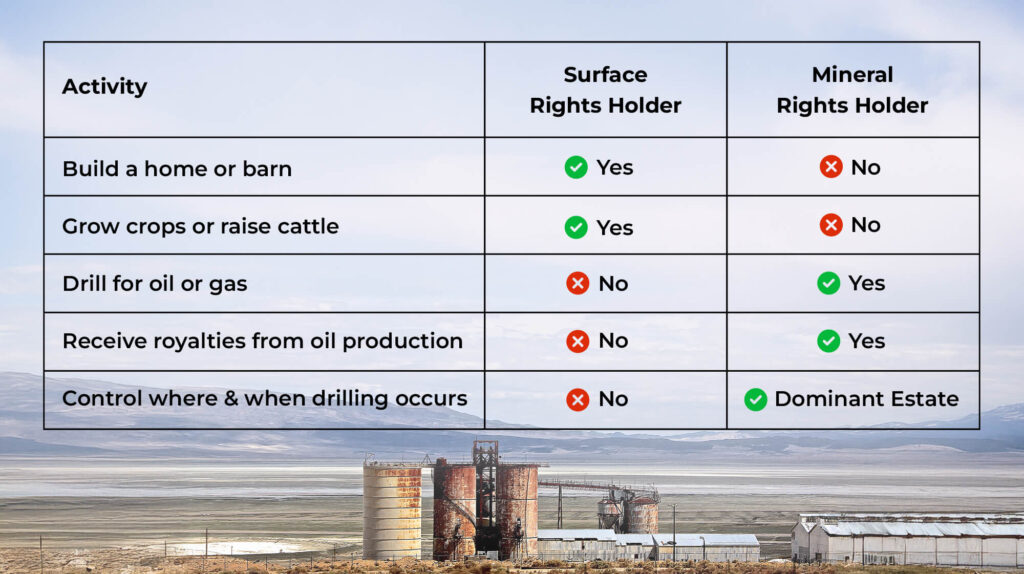
    • Full ownership of the subsurface resource deposits beneath a tract of land. This is different than a surface interest (SI), which refers to use and ownership of anything existing on the property surface.  Mineral and surface owners may be the same or different.  
  • Full Executive Rights: 
    • The mineral interest owner has full executive rights to lease the minerals to an oil and gas company for exploration and production. 
    • Even if the surface owner is different, in most parts of the United States the mineral estate takes precedence over the surface estate, which means the mineral owner has an unobstructed right to extract natural resources from their parcel however they see fit, provided they pay surface damages to the surface interest owner for anything they destroy or impair use of.
  • All Revenue Streams: 
    • Owners can receive all types of production and property-related income, including lease bonuses, delay rental payments, and production royalties.
  • For a more in-depth discussion of this interest type, check out our blog What Are Mineral Interests?

Royalty Interest (RI)

  •  Created From Lease Agreements
    • Royalty interests are created when a mineral interest owner leases their minerals to an exploration and production company to extract the minerals.  The royalty interest is the right to receive a portion of the revenue from the sale of the crude oil, natural gas, or other hydrocarbons extracted by the wells.
  • Revenue Without Costs
    • Royalty interest owners receive this percentage of the revenue from production without bearing any of the production costs.  All costs are borne by the operator.
  • Distinct From Mineral Interest
    • At the time a lease is signed, both the mineral interest and associated royalty interest are typically held by the same party. However, the two interests are technically distinct, so it is possible for one to be sold while the other is retained. Although this is somewhat uncommon, it can and does occur. 

Working Interest (WI)

  • Operational Interest
    • The E&P company, or operator, who actively drills wells on a particular parcel of land will typically incur 100% of the costs associated with drilling and maintenance of the wells in exchange for interest in 75%-87.5% of the revenue from production (being the amount remaining after paying other, non-cost bearing interest types). This interest is collectively called the Working Interest (WI).
  • High Risk and Reward
    • This interest type carries the potential for high returns (since the operator receives a majority share of the income from wells drilled) but also comes with significant financial obligations and risks since they must also bear very high operational costs. 
    • If a well is drilled at great expense and only a small amount of (or no) hydrocarbons are produced, this is called drilling a “dry hole”. In this case, the operator will sustain great financial losses related to the drilling of the well. The mineral interest and royalty interest owners, on the other hand, will have sustained no losses. 
  • Sometimes Referred To As A “Leasehold Interest”
    • Some time will typically elapse between a parcel of land being leased and wells actively producing on it. During this initial duration, operators will typically refer to their interest in the land as a “Leasehold Interest”. This is essentially a synonym for the term “Working Interest”, but simply refers to the time period before production begins. If an operator lets a lease term lapse, it is possible that a “Leasehold Interest” might never be referred to as a “Working Interest” since no wells were ever drilled.

Overriding Royalty Interest (ORRI)

  •  Carved from Working Interests
    • Overriding Royalty Interests (ORRIs) are linked to the revenue generated from the sale of minerals produced under a specific lease, rather than to direct ownership of the minerals themselves. These interests are created by operators from the Working Interest when they finalize a lease agreement with mineral owner(s). Once established, they can be bought and sold freely until the associated lease terminates. Upon lease expiration, ORRIs become void alongside the Working Interest. However, as long as there is a producing well, the lease remains “held by production” and will not expire until the well ceases production.
  • Not Cost Bearing
    • Like traditional mineral and royalty interests, ORRIs are non-cost-bearing.  ORRI owners are not responsible for any costs associated with the drilling and maintenance of the wells drilled on the lease with which they are associated. 
  • Common Origin
    • ORRI interests are typically created by operators as a form of incentive compensation to geologists, engineers, and landmen who work for them, without giving them ownership of the actual resource (like minerals) or responsibility for any project-related decision-making or costs.

Non-Participating Royalty Interest (NPRI)

  •  Mineral Interest with No Executive Rights
    • This type of interest gives owners a financial stake in a specific mineral parcel, but they lack the authority to lease the mineral rights to others or collect lease bonuses or delay rental payments. Their earnings are solely based on the production of minerals from the land, similar to a royalty interest.
  • Common Origin
    • Non-Participating Royalty Interests (NPRIs) are often established during inheritance distribution. When a mineral interest is divided, one portion may retain the executive rights—the ability to make leasing decisions—while the other parts are designated as NPRIs. This setup allows revenue from mineral production to be shared among all heirs, even though only one retains the authority to manage the rights.

Non-Operated Working Interest (aka “Non-Op Interest”)

  •  A Passive Working Interest
    • This type of ownership allows individuals to share in production revenues and costs without being involved in day-to-day operational decisions. It is partitioned from the overall Working Interest that is created when an operator enters into a lease agreement with a mineral owner.
  • Common Origin
    • Non-Operated Working Interests can arise in several ways, such as through joint venture agreements between multiple operators, risk-sharing arrangements, or as part of an incentive structure, much like Overriding Royalty Interests.
  • Tax Benefits
    • While Non-Operated Working Interest holders assume more financial risk than those with non-cost-bearing interests, they may benefit more from tax deductions tied to their share of production expenses, all while not being responsible for managing any day-to-day operations.

Net Profits Interest (NPI)

  •  Royalty Interest, With Some Deducted Costs 
    • With a Net Profits Interest, the owner’s earnings are calculated based on the net income from mineral production after specific costs are subtracted. For instance, if transporting hydrocarbons from the wellhead to the point of sale incurs significant costs, an operator may establish an NPI to deduct these expenses from royalty distributions.
  • Non-Operational & Passive
    • NPIs are considered passive interests, similar to Royalty Interests, NPRIs, and ORRIs, meaning they do not involve direct participation in the production process or any costs related thereto.

Conclusion

Although this list includes all of the most common interest types, there are several other, radically less common varieties which you may encounter.  If you believe you have a different type of interest than any described here and would like to better understand it, please feel free to reach out to us (see our Contact Us page) and we would be happy to discuss with you.

What Are Mineral Interests

What Are Mineral Interests?

What are mineral interests, how are they monetized, and what are the legal frameworks that govern them? If you receive royalty payments from oil & gas production on property you own, it’s critical to know the answers to these questions – though the answers can be hard to come by! This blog post will address many of the “basics”:

What Are Mineral Interests?

Mineral interests are also known as “mineral rights”, and they represent a unique and valuable category of real estate ownership in the United States. Unlike most countries of the world, where the government retains ownership of all subsurface minerals, the United States allows private individuals and entities to possess these rights. 

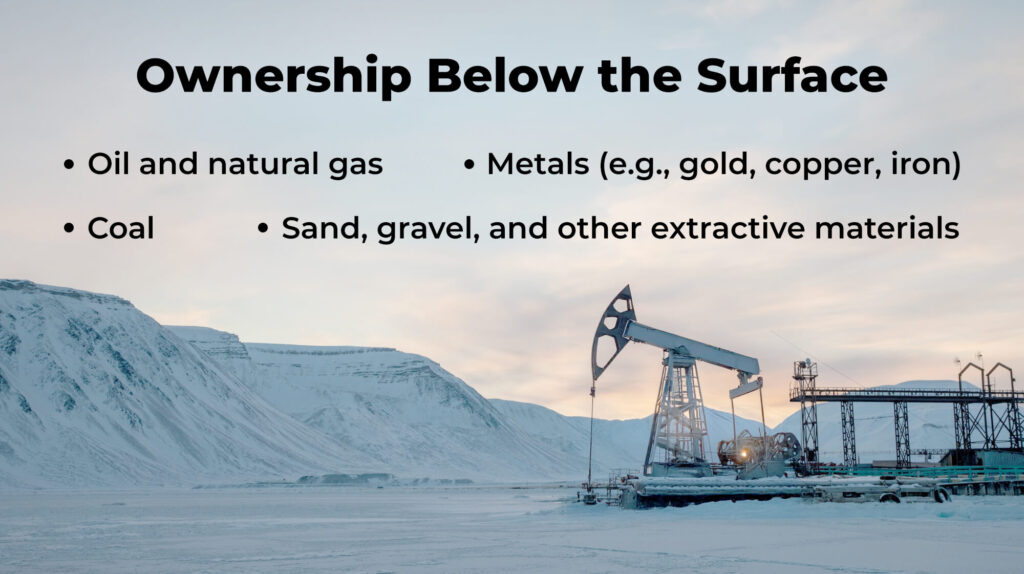
Owning mineral interests in a parcel of land gives the holder the right to extract and profit from natural resources existing beneath the surface. These resources can include coal, lithium, gold, and silver, but in the United States, the most economically significant minerals are oil, natural gas, and related hydrocarbons.

A notable feature of mineral rights is that they can be (and often are) separated, or “severed”, from surface rights. This means the individual or entity owning the land’s surface may not necessarily own the mineral resources below. Two primary ownership classifications define the structure of mineral estates:

  • Fee Simple Estate: Both surface and mineral rights are owned by the same party.
  • Severed Estate: Mineral rights have been legally separated from surface rights, with different owners for each. Typically, this severance occurs below a certain depth, often around 100 meters. In regions with significant oil and gas production, the majority of parcels are severed estates.

How Are Mineral Interests Monetized?

Mineral interests transition through various stages before reaching their full monetization potential. Initially, they are classified as “non-producing” until valuable deposits are identified and extraction operations commence. Non-producing mineral interests are generally exempt from property taxes due to the uncertainty of the resources’ value (if any).

Here’s the lifecycle mineral interests typically follow in the oil and gas industry to ultimately generate revenue:

  1. Likely Deposits Located:  Exploration and production (E&P) companies, often referred to as “operators,” search for valuable oil, gas, or other hydrocarbon deposits. This process involves advanced geological techniques and technologies which have radically improved over the last 150 years, but even now, the presence and amount of deposits isn’t known for certain until drilling operations are completed. These E&P companies are said to operate in the “upstream” sector of the oil and gas industry because they focus on resource extraction.
  2. Mineral Interests Leased:  Once deposits are identified, the operator negotiates with the mineral rights owner(s) to lease their interests. This involves the mineral owner(s) signing an oil and gas lease (OGL) that grants the operator extraction rights in exchange for a lease bonus, a royalty percentage of any production revenue (typically 12.5% to 25%), lease duration, and various other agreed-upon terms. If no wells are drilled during the lease term—usually 3-5 years—the mineral interests revert to being unleased and the mineral owner(s) will have the ability to lease again, to a different operator.
  3. Drilling & Production:  After obtaining the necessary permits, operators drill wells to extract hydrocarbons. Operators cover 100% of the drilling and production costs, ensuring no financial burden on the mineral owner(s). The extracted resources are then sold to “midstream” companies, which handle transportation and refining. Refined products like gasoline and diesel are eventually sold to “downstream” companies or directly to consumers. In some cases, large operators manage their own midstream and downstream operations, streamlining the process. Once a mineral interest becomes “producing,” it is subject to annual property taxes based on its appraised value.

Mineral Interests Legal Framework

In the United States, mineral rights ownership is shaped by a combination of federal and state laws. Federal legislation, such as the Mineral Leasing Act and the Mining Law of 1872, establishes broad guidelines, while state laws provide detailed regulations that vary significantly across regions. States like Texas, Oklahoma, and North Dakota have specific rules tailored to their abundant mineral resources.

Like other forms of real estate, mineral rights can be leased, sold, or inherited. These transactions must comply with both federal and state laws, which include numerous administrative and title requirements. The complexity of transferring mineral rights often leads to title disputes and other challenges.

Conclusion

Mineral interests are a vital component of the United States energy sector and real estate market. Understanding property types, the monetization process, and the regulatory framework is essential for all stakeholders. For additional important reading, take a look at our companion blog Types Of Mineral & Royalty Interests for additional information on the various financial interest types which exist today in addition to the basic “Mineral Interest” discussed above.