Blogs

From Drilling Permit to First Royalty Check: What Mineral Owners Should Expect

Seeing a new drilling permit tied to your minerals can be exciting. Maybe a landman mentioned a new well. Maybe a rig appeared nearby. Or maybe you found a permit while checking public records and immediately wondered the obvious question: when will the royalty checks start?
The answer is usually not ‘right away.’ A drilling permit is only the beginning of a chain of events that can include site preparation, drilling, completion, first production, title review, division orders, sales reporting, and finally payment. Some wells move through that sequence quickly. Others pause for months between stages. And some permitted wells are never drilled at all.
For mineral and royalty owners, knowing what happens between a permit and a first check makes the waiting period much less mysterious. It also helps you recognize when normal timing has turned into a paperwork, title, or payment problem that deserves a closer look.
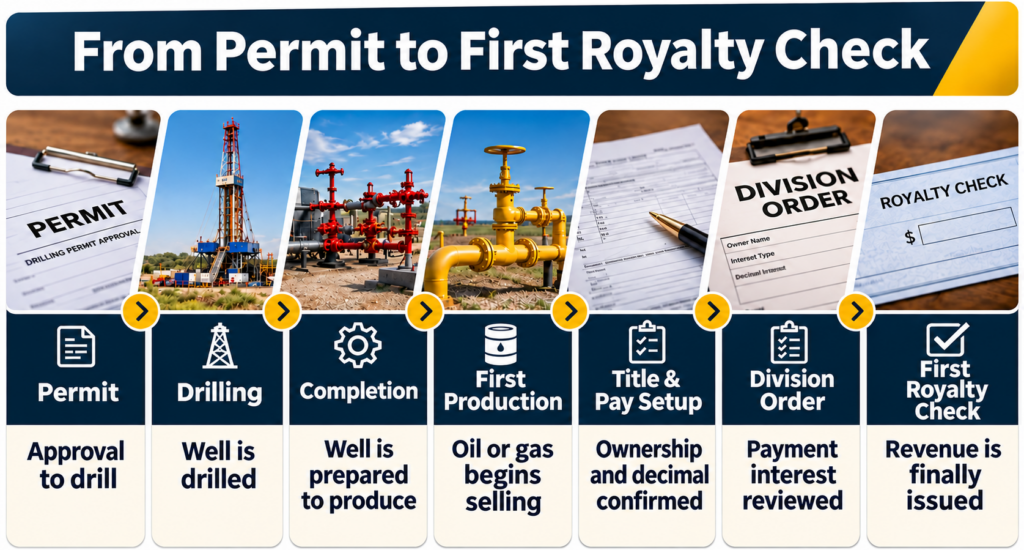
At a Glance: The Typical Path
| Stage | What It Usually Means |
| 1. Permit | The operator has regulatory approval to drill a proposed well, subject to the permit and applicable rules. |
| 2. Drilling | The well is spudded and drilled to the planned target. A drilled well is not necessarily ready to produce. |
| 3. Completion | Casing, perforating, hydraulic fracturing and related work prepare the well to flow oil or gas. |
| 4. First production | The completed well begins producing and hydrocarbons are measured and sold. |
| 5. Title & pay setup | The payor confirms who owns the revenue and calculates each owner’s decimal interest. |
| 6. Division order | The owner may receive a division order confirming the property, owner and payment decimal. |
| 7. First royalty check | Payment is issued after production is sold, ownership is cleared and the pay cycle is reached. |
Step 1: A Drilling Permit Is a Green Light – Not a Promise
A drilling permit means the operator has received regulatory authorization to drill a proposed well. It is an important signal because the operator has spent time and money identifying a location, preparing a plat, and filing the required application. But a permit is not the same thing as a producing well.
Operators can change development schedules because of commodity prices, rig availability, pipeline capacity, capital budgets, acreage priorities, title issues, or changes in the drilling plan. In Texas, for example, the Railroad Commission generally gives an operator two years from initial permit approval to spud the well. That alone illustrates why a newly approved permit should be viewed as a sign of intent, not a guaranteed payment date.
Owners should also remember that the surface location can be some distance from the minerals that ultimately participate in the well. Horizontal wells may cross several tracts or be associated with pooled or allocation acreage. A permit near your property is encouraging, but participation should be confirmed from the unit, plat, lease and title records rather than from the visible drilling pad alone.
Step 2: The Well Is Spudded and Drilled
Once the operator begins drilling, the well is said to be ‘spudded.’ Drilling then proceeds through the planned vertical and, for many modern wells, horizontal sections of the wellbore. The operator sets casing and performs the work needed to reach and isolate the target formation.
This is an important milestone, but drilling completion still does not mean royalty income is about to begin. Drilling and well completion are separate operations. Different crews and equipment are typically involved, and an operator may intentionally drill several wells before bringing in a completion crew to finish them in a batch.
That is why industry reports often refer to DUCs – drilled but uncompleted wells. A DUC has been drilled but has not yet gone through all of the completion work necessary to begin producing hydrocarbons. Some DUCs move to completion quickly; others can sit for months depending on economics, scheduling and infrastructure.
Step 3: Completion Turns a Drilled Well Into a Producing Candidate
Completion is the stage that prepares the well to actually produce. For a modern horizontal shale well, that can include casing and cement work, perforating the target intervals, hydraulic fracturing, installing production equipment, and flowing the well back before stable production begins.
This stage is one reason the gap between ‘the rig left’ and ‘the well is producing’ can confuse mineral owners. The drilling rig may be gone, yet significant work may still remain. In public records, completion reports are often a much stronger indication that the well has reached the producing stage than the original drilling permit by itself.
In Texas, oil and gas well records typically include the original drilling permit and later completion reports, along with other well documents. Owners who enjoy following public records can use those filings to see whether a well has moved from the permitted stage into a completed status.
Step 4: First Production Is Not the Same as First Payment
Once a completed well begins flowing and hydrocarbons are measured for sale, the well has reached first production. This is the point many owners have been waiting for – but it is still not necessarily the date a royalty check is generated.
Royalty payments are based on oil and gas that is produced and sold. Production has to be measured, allocated to the correct well or unit, priced under the applicable sales arrangement, and reported through the operator or purchaser’s accounting system. Depending on the product and the payor, there can be a normal lag between the month of production and the month the revenue appears on a statement.
That lag is why the production month printed on a revenue statement often predates the check date. Our earlier guide, How to Read a Revenue Statement, explains the production date, volumes, sales price, decimal interest, taxes and deductions that eventually come together to create the payment amount.
Step 5: The Payor Has to Confirm Who Gets Paid – and How Much
Before distributing revenue, the operator or other payor needs a reliable ownership record. In industry language, that ownership setup is often called the pay deck. It identifies each party entitled to proceeds and the decimal interest assigned to that owner for a particular property or well.
This title and payment setup can be simple when one owner has clean records and the lease history is straightforward. It can take longer when minerals have been inherited several times, ownership is split among many heirs, deeds contain reservations or exceptions, trusts or entities are involved, or the operator is missing documents needed to confirm title.
A well can therefore be producing while an individual owner’s money is still being held. That does not mean the production disappeared. It can mean the payor has not finished confirming the ownership or does not yet have the paperwork needed to release the funds.
Step 6: The Division Order Usually Arrives Before Regular Payments
Once the payor has calculated the ownership, many mineral owners receive a division order. This document typically identifies the owner, property or well, interest type, and decimal interest that will be used for payment.
A division order should not be treated as routine mail. Compare the owner name, property, well or unit, interest type and decimal with your records before signing. A decimal that looks unexpectedly small is not automatically wrong – especially in a large pooled unit – but you should be able to understand how the number was derived at a high level.
Our articles Division Orders Explained and Pooling and Unitization Explained are useful companions here. They walk through what to review and why the acres you own are only one part of the royalty calculation.
Step 7: When Should the First Royalty Check Arrive?
There is no single nationwide answer. Payment timing depends on state law, the lease or other governing agreement, the payor’s cycle, title status, the amount accrued, and whether any valid payment hold exists.
Texas provides a useful example because many Allegiance readers own interests there. Under the Texas Natural Resources Code, proceeds from the first sale of oil or gas generally must be paid no later than 120 days after the end of the month of first sale, subject to statutory exceptions that can allow payment to be withheld. Ongoing payment deadlines differ for oil and gas when the lease or another written agreement does not specify timing.
| Important: The Texas 120-day rule is an example, not a nationwide deadline. Royalty-payment laws vary by state, and valid title disputes, missing ownership information, payment thresholds, lease terms or other circumstances can affect when a particular owner is paid. |
If everything is clean, the first check can still feel delayed because it may represent production from months earlier. In some cases that first payment is larger than a normal monthly check because several production months are being paid together. The revenue statement should show the production months included so you can separate a catch-up payment from a true one-month royalty amount.
Why the First Check May Take Longer Than You Expected
If a well has been producing for a while and you still have not been paid, work through the reason before assuming the operator simply forgot about you. Common explanations include:
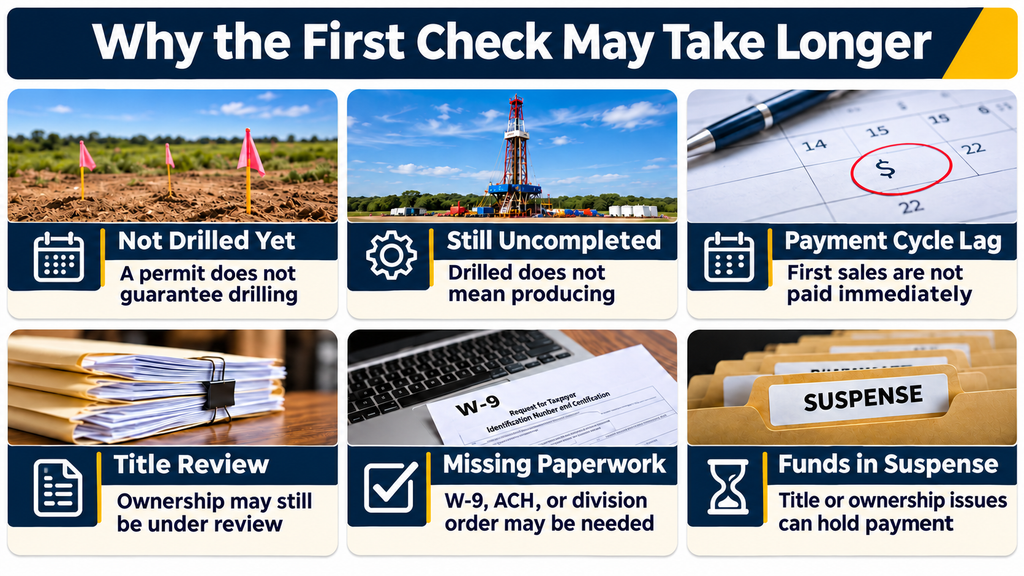
- The permit was approved, but the well has not actually been drilled.
- The well was drilled but remains uncompleted or has not yet reached first production.
- Production has started, but the first sales and accounting cycle have not yet reached payment.
- The payor is still reviewing title or waiting for probate, deed, trust, assignment or other ownership documents.
- A division order was sent but has not been returned, or the owner disputed the decimal and the file is under review.
- The payor is missing a W-9, address update, ACH form or other required owner information.
- The owner balance has not yet reached the payor or state-law payment threshold.
- Funds are in suspense because of a title dispute, adverse claim, ownership change or other payment hold.
- Oil and gas are being sold through different purchasers, so one product may begin paying before the other.
If the issue is true suspense rather than ordinary timing, our article Suspended Royalties: Why Payments Get Held Up and How To Fix It explains what to ask owner relations and which documents to have ready.
What Mineral Owners Can Monitor While They Wait
You do not need to call the operator every week to stay informed. A small set of records can usually tell you where the well sits in the process.
- Drilling permit: Confirms the proposed location, operator, well name or number, target field or formation, and other permit details.
- Well or completion records: Help show whether the well was drilled and whether a completion has been filed.
- Public production data: Can show when reported production begins, although public reporting can lag behind field activity.
- Pooling or unit documents: Help confirm whether your acreage is included and how the well relates to your tract.
- Owner-relations correspondence: Watch for W-9 requests, address forms, ACH paperwork, title requirements and division orders.
- Division order: Review the property, interest type and decimal before signing.
- First revenue statement: Compare production month, volumes, prices, decimal, taxes and deductions before treating the check amount as a permanent monthly baseline.
A Simple Example: Why the First Check Can Be Bigger Than the Next One
Imagine a new horizontal well begins selling production in January, but the owner’s title setup and payment cycle are not completed until April. The first check might include January, February and March production together. Because new horizontal wells often produce most strongly early in their lives, those first months may also carry unusually high volumes.
The result can be a very large first payment followed by smaller checks. That does not automatically mean the operator made a mistake or that the well suddenly underperformed. Part of the difference may simply be that the first check included several months at once, and part may reflect the normal early decline of the well.
This is where our recent Decline Curves Explained article becomes important. The first royalty check tells you what was paid. The production history tells you whether that payment level is likely to repeat.
When It Is Worth Contacting Owner Relations
There is no need to chase a check merely because a permit was approved or a rig was seen on location. But once you know a well is producing and selling hydrocarbons, unanswered questions become more reasonable.
Contact owner relations when:
- Public or operator information shows sustained production, but you have received no ownership or payment paperwork.
- Other family members with the same chain of title are receiving division orders or checks while you are not.
- The operator says your interest is suspended but cannot explain the reason.
- A division order credits materially fewer acres or a different royalty rate than your records indicate.
- The first payment arrives but the production months, decimal interest, or property identifiers do not match what you expected.
- The payor requests documents you have already supplied and cannot confirm whether they were accepted.
When you call, have the owner number if you have one, well or lease name, county and state, copies of relevant deeds or probate documents, the lease, and any division order or correspondence in front of you. Specific questions usually get better answers than simply asking, ‘Where is my check?’
How This Timeline Affects Mineral Value
A permitted well, a drilled well, a completed well and a producing well do not carry the same level of certainty. Buyers evaluating mineral interests often distinguish among these stages because each milestone changes the probability and timing of future cash flow.
A permit may indicate development interest, but the well can still be delayed or never drilled. A drilled but uncompleted well is further along, yet it still has to be completed and placed on production. Once a well is producing, there is real production data to evaluate – but the early months may be unusually strong and subject to a steep decline curve.
For owners considering an offer, that means timing matters. An offer made when a well is only permitted may price the development risk differently from an offer made after completion or first production. The highest visible royalty check is also not necessarily the best measure of long-term value. Location, operator plans, remaining drilling inventory, production decline, commodity prices, title quality and the specific rights attached to the interest all matter together.
How Allegiance Oil & Gas Helps Mineral Owners
At Allegiance Oil & Gas, we regularly speak with owners who know that drilling activity is happening but are not sure what stage the well has reached, whether their acreage participates, or what that activity means for the value of their interest.
Our approach is to look at the full picture: ownership, lease terms, unit structure, well status, operator activity, production, and the development potential that may still remain. Whether you plan to keep your minerals, sell a portion, or evaluate an offer, understanding where a well sits between permit and payment can help you make a more informed decision.
Final Thoughts
The path from drilling permit to first royalty check is rarely one straight line. A permit is an important signal, but the well still has to be drilled, completed, placed on production, tied into a sales stream, matched to the correct ownership, and processed through the payor’s accounting system.
For mineral owners, the best approach is to follow the milestones rather than the rumors. Confirm the permit. Watch for drilling and completion records. Verify that your acreage participates. Keep your ownership information current. Review the division order carefully. Then use the first revenue statement to understand exactly which production months and wells are being paid.
When those pieces line up, the first check becomes much easier to understand – and you will have a much better foundation for evaluating what the well may mean for future income and the value of your mineral interest.
Disclaimer: This article is for general informational purposes only and is not legal, tax, engineering, accounting, or investment advice. Drilling, completion, title, division-order, royalty-payment, pooling, and reporting requirements vary by state, lease, well, operator, payor, and ownership history. Mineral and royalty owners should consult qualified professionals regarding their specific circumstances.