Blogs

Pooling and Unitization Explained: Why Your Royalty Depends on More Than the Acres You Own

A mineral owner may know exactly how many acres the family owns and still be surprised by the royalty decimal on a division order or revenue statement. The well may not sit on the owner’s tract. The unit may cover hundreds or even thousands of acres. And a payment that looked simple in theory may arrive with a decimal so small that it seems impossible to verify.
That confusion usually starts with pooling and unitization. These arrangements allow oil and gas development to cross property lines and treat multiple tracts, leases, or interests as part of a larger operating area. They can make drilling more efficient and ensure that owners share in production, but they also mean your royalty depends on more than the number of gross acres shown on a deed.
Below is a practical explanation of what pooling and unitization mean, how they can affect royalty calculations, and what mineral owners should review when the numbers do not make sense.
Why Oil and Gas Development Rarely Stops at Property Lines
Oil and gas reservoirs do not follow fence lines, county records, or family ownership boundaries. Modern horizontal wells can travel long distances underground and may produce hydrocarbons associated with several tracts. An operator therefore needs a legal and regulatory framework for developing the resource and allocating production among the affected interests.
Pooling and unitization are two of the tools used to create that framework. The exact terminology and legal effect vary by state, lease, regulatory order, and operating agreement. In everyday conversation, people also use the word “unit” loosely, which is one reason owners can receive paperwork that appears inconsistent even when the underlying concepts are different.
What Pooling Means
Pooling generally combines separate tracts, leases, or mineral interests for the purpose of drilling and producing one or more wells within a defined area. Instead of treating each small tract as though it must support its own well, the pooled acreage participates in production from the well or wells assigned to the pooled unit.
For a mineral owner, pooling usually does not mean the mineral interest has been sold or that title has disappeared into a new entity. The owner still owns the underlying interest. What changes is the way production is shared and, in many cases, the way the lease is maintained by production.
Pooling authority may come from the pooling clause in an oil and gas lease, a separate pooling agreement or ratification, or a compulsory pooling or integration order issued under state law. Whether an operator can pool without obtaining a new signature depends on the lease language and the law that applies to the property.
What Unitization Means
Unitization is usually broader than ordinary lease pooling. It commonly refers to coordinated development or operation of a larger reservoir or geologic area, sometimes involving multiple operators, leases, and producing tracts. Unitization is often used when treating the reservoir as a single operating system can improve recovery, reduce duplicate facilities, or support secondary recovery methods such as waterflooding.
The owner’s share in a unitized operation may be determined by a participation formula that considers more than surface acreage. Depending on the agreement or order, factors may include productive acreage, reservoir characteristics, pore volume, historical production, well contribution, or another negotiated allocation method.
This distinction matters because an owner should not assume every document containing the word “unit” uses the same calculation. A pooled drilling unit may allocate production primarily by acreage, while a larger unitization agreement may use a more complex participation schedule.
Pooling, Spacing, and Unitization Are Related – But Not Identical
A state regulator may establish a spacing or drilling unit to control well density, prevent waste, and protect the rights of owners in a reservoir. Pooling then addresses how separate interests within the relevant area are combined or integrated for development. Unitization can go further by coordinating operation of a broader common source of supply.
The concepts overlap, but they should not be treated as interchangeable. A regulatory spacing designation does not always answer every private lease or royalty question, and a lease pooling clause does not necessarily authorize every type of allocation or unitization. That is why owners should review the actual lease, unit documents, orders, and division order rather than relying on the unit name alone.
A Simple Royalty Decimal Example
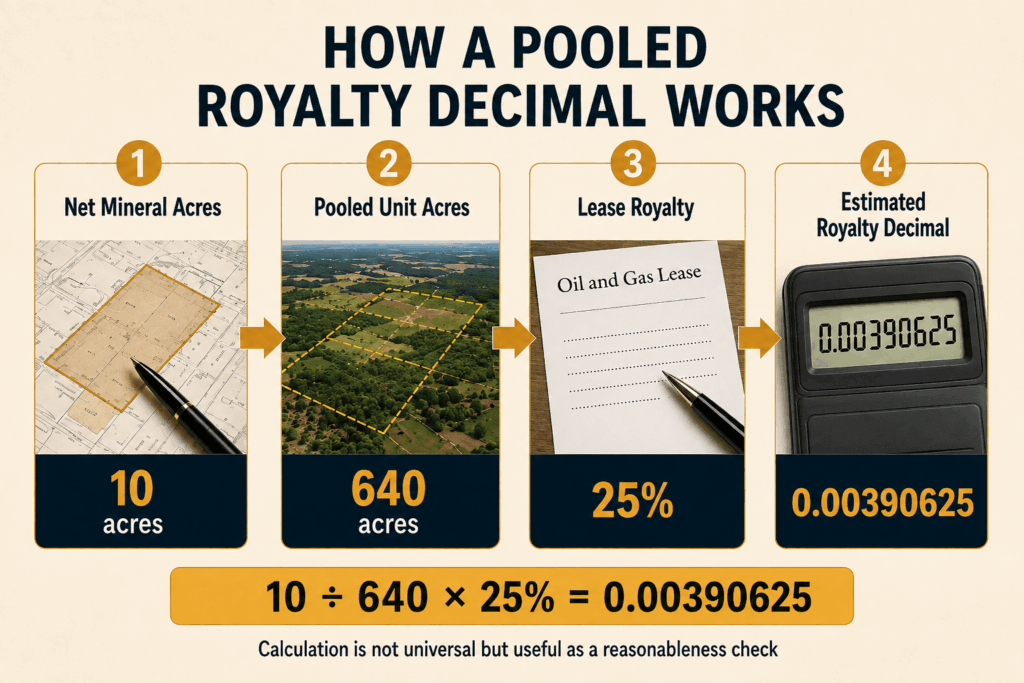
For many conventional pooled units, an owner’s royalty decimal can be estimated using three basic inputs: net mineral acres, unit acres, and the lease royalty rate.
| Estimated royalty decimal = (net mineral acres / pooled unit acres) x lease royalty rate |
| Example: An owner has 10 net mineral acres in a 640-acre pooled unit and a 25% lease royalty. The estimated decimal is 10 / 640 x 0.25 = 0.00390625. If the well generated $100,000 of gross revenue for the month, that decimal would represent about $390.63 before taxes, adjustments, and any deductions permitted by the lease. |
The calculation is useful as a reasonableness check, but it is not universal. Allocation wells, cross-unit laterals, overlapping units, tract participation factors, depth limitations, title adjustments, and state-specific rules can all produce a different result. The formula should help an owner ask better questions, not replace a review of the governing documents.
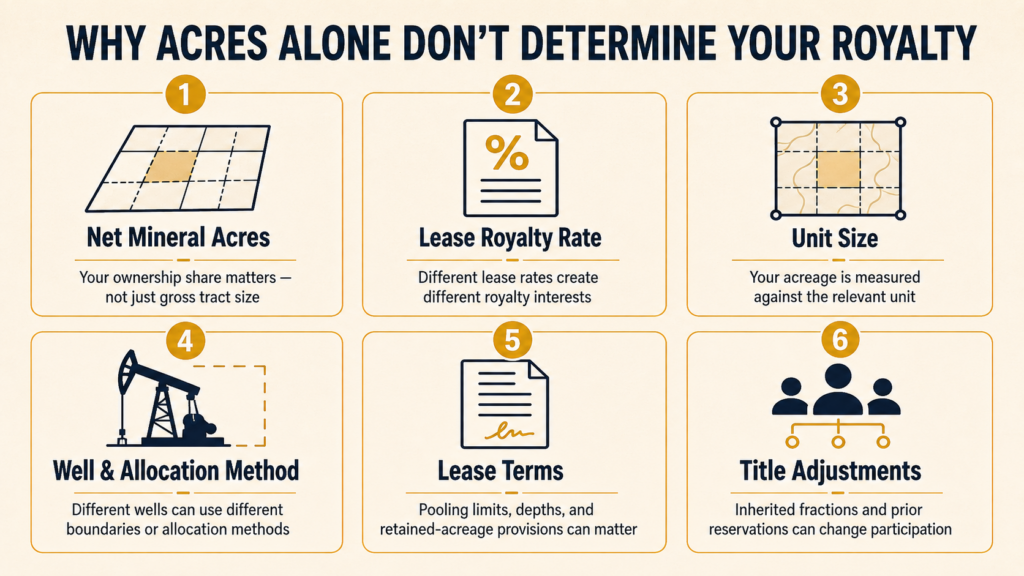
Why Your Royalty Depends on More Than Gross Acres
1. Gross acres are not the same as net mineral acres
A deed may describe a 40-acre tract, but the owner may hold only one-half, one-quarter, or an even smaller fraction of the minerals. If you own one-half of the minerals under 40 gross acres, you generally have 20 net mineral acres. The net figure – not the gross tract size by itself – is the starting point for most ownership calculations.
2. The lease royalty rate matters
Two owners with the same net mineral acreage in the same unit can receive different royalties if their leases carry different royalty rates. A one-eighth lease and a one-quarter lease do not create the same decimal, even when the acreage is identical.
3. The unit size changes the fraction
Your tract’s participation is measured against the relevant unit or allocation area. Ten net mineral acres in a 160-acre unit represent a much larger fraction than ten net mineral acres in a 640-acre unit. This is often the main reason a decimal looks smaller than an owner expected.
4. Not every well uses the same unit or allocation method
One property can participate in several wells with different unit boundaries, formations, lateral paths, or allocation schedules. A decimal that is correct for one well may be wrong for another. Owners should compare the property and well identifiers rather than assuming every check from the same operator should use the same number.
5. The lease may limit what can be pooled
Some leases cap unit size, restrict pooling by formation or depth, require consent, or include retained-acreage or Pugh-clause language. Those provisions can affect what acreage is held by production and whether acreage outside the producing unit is released when the primary term ends.
6. Title adjustments can reduce or change participation
Inherited fractions, prior reservations, NPRIs, royalty burdens, correction deeds, and unresolved title requirements can all affect the decimal. The acreage may be correct while the ownership fraction is not, or vice versa.
7. The final check also reflects production and pricing
The royalty decimal determines the owner’s share, but the payment amount also depends on well production, commodity price, product mix, taxes, prior-period adjustments, and deductions allowed under the lease. A lower check does not automatically mean the pooling calculation changed.
Does the Well Have to Be Located on Your Tract?
Not necessarily. If your minerals are properly included in a pooled unit, you may share in production from a well whose surface location and wellbore are not directly on your tract. The basic idea is that participating acreage shares in the unit’s production according to the governing allocation method.
The reverse is also important: seeing a well near your property does not prove that your minerals are included. Proximity is not the same as participation. The unit designation, plat, legal description, regulatory records, and division order are more reliable than a map pin or the visible location of a drilling pad.
Can Pooling Affect How Long Your Lease Stays in Force?
Often, yes. Many leases provide that production from anywhere within a valid pooled unit is treated as production from each leased tract included in that unit. That can keep the lease in force beyond its primary term even when the producing well is not physically located on the owner’s acreage.
How much acreage and which depths remain held depends on the lease. A Pugh clause, depth-severance clause, retained-acreage provision, continuous-development clause, or pooling limitation may release acreage or formations that are not part of ongoing development. Owners should not assume that one pooled well automatically holds everything – or that it holds nothing outside the well’s immediate location.
What Mineral Owners Should Review
When a royalty decimal or unit description looks unfamiliar, start with the documents that control the ownership and payment setup.
- The oil and gas lease, including amendments, extensions, pooling clauses, and any Pugh or retained-acreage provisions
- The recorded declaration of pooling, unit designation, pooling agreement, ratification, or unitization agreement
- The unit plat or exhibit showing the participating tracts, acreage, formation, and effective date
- The division order, especially the property description, well name, decimal interest, and owner name
- Deeds, probate records, trust documents, and prior reservations that establish your net mineral ownership
- Revenue statements showing the well, unit, product, decimal, production volume, price, taxes, and adjustments
- Public well and unit records maintained by the applicable state oil and gas regulator
The goal is to make sure the same story appears across the documents: the correct owner, the correct tract, the correct unit, the correct formation or depth, and a decimal that can be traced to the ownership and allocation method.
Questions Worth Asking the Operator or Payor
- What unit, allocation area, or participating area is this well assigned to?
- How many net mineral acres does your title file credit to my interest?
- What lease royalty rate and ownership fraction were used?
- Was the decimal calculated by acreage, lateral length, a tract factor, or another allocation method?
- Is this decimal specific to one well, one formation, or the entire unit?
- Has the unit been amended, expanded, reduced, or replaced since the original division order?
- Does the operator have a copy of every deed, probate document, or assignment affecting my ownership?
- Can you provide the unit designation, plat, or calculation support used for the division order?
When a Small Decimal Is Normal – and When It Deserves a Second Look
A tiny decimal is not automatically an error. Fractional ownership, a large unit, and a modest lease royalty can produce a very small number even when the calculation is correct. But owners should investigate when the decimal cannot be reconciled at a high level or when the documents point in different directions.
- The credited net mineral acres are materially lower than your deed or probate records suggest
- The unit acreage or legal description does not match the well or property on the division order
- A new division order changes the decimal without explaining a new well, unit, title update, or allocation method
- One heir is being paid while similarly situated co-owners are suspended or omitted
- The lease appears to restrict pooling, but the operator cannot identify the authority used
- Revenue statements use a decimal that differs from the signed division order and no adjustment is shown
In a straightforward case, owner relations may be able to explain the calculation. More complicated issues may require a land professional, title specialist, engineer, or oil and gas attorney, particularly when the dispute involves lease authority, compulsory pooling, unitization participation, or conflicting title claims.
Why Pooling and Unitization Matter to Mineral Value
Pooling and unitization do more than determine a monthly royalty check. They can affect whether acreage is considered developed, which wells contribute to cash flow, what future drilling inventory may exist, how long a lease remains in force, and how a buyer evaluates the interest.
A mineral interest with only a few net acres may still be valuable if those acres participate in strong wells or sit within an active development area. Conversely, a larger gross tract may produce less value when ownership is heavily fractionalized, the royalty rate is low, the unit allocation is unfavorable, or development is uncertain. This is another reason offers quoted simply “per acre” can be misleading unless everyone is talking about the same kind of acre and the same participation rights.
How Allegiance Oil & Gas Helps
At Allegiance Oil & Gas, we regularly work with owners who know where their minerals are located but are less certain about how a pooled unit, royalty decimal, or division order affects the property’s actual value. The answer is rarely found in acreage alone. It requires looking at the title, lease terms, unit structure, production, operator activity, and the specific rights attached to the interest.
Our goal is to help mineral and royalty owners understand the asset before making a decision. Whether you are reviewing payments, evaluating inherited minerals, or considering an offer, clear information makes it easier to decide whether holding, selling, or selling only a portion best fits your situation.
Final Thoughts
Pooling and unitization can make mineral ownership look more complicated than it really is. The clearest way to think about them is this: your tract may be only one piece of a larger development area, and your royalty reflects both what you own and how that larger area shares production.
Start with your net mineral acres, not just the gross tract size. Confirm the lease royalty. Identify the correct unit and well. Then compare the unit documents, division order, and revenue statement. When those pieces line up, even a very small decimal can usually be explained. When they do not, asking specific questions early can prevent years of incorrect or delayed payments.
Disclaimer: This article is for general informational purposes only and is not legal, tax, engineering, or investment advice. Pooling, compulsory integration, spacing, unitization, lease-maintenance rules, and royalty allocation methods vary by state, lease, order, well, and ownership history. Mineral owners should consult qualified professionals regarding their specific circumstances.